

Guides AI Agents & Automation
Google Launches New Gemini Tools for Small Businesses: Brand Design, App Connections and Financial Insights
Google has announced new Gemini features for small-business owners, including a dedicated business hub, reusable brand styles, expanded app connections, and financial analysis tools. Announced globally on October 20, 2026, the update aims to bring everyday business workflows into one AI assistant. Here's what is changing, who can access it, and where the limitations remain.
Google Launches New Gemini Tools for Small Businesses: What's New in October 2026? #
Running a small business often means switching between several different jobs throughout the day.
One moment, you're preparing a marketing campaign. Next, you're reviewing expenses, checking customer feedback, or updating product information.
Each task may involve a different software platform.
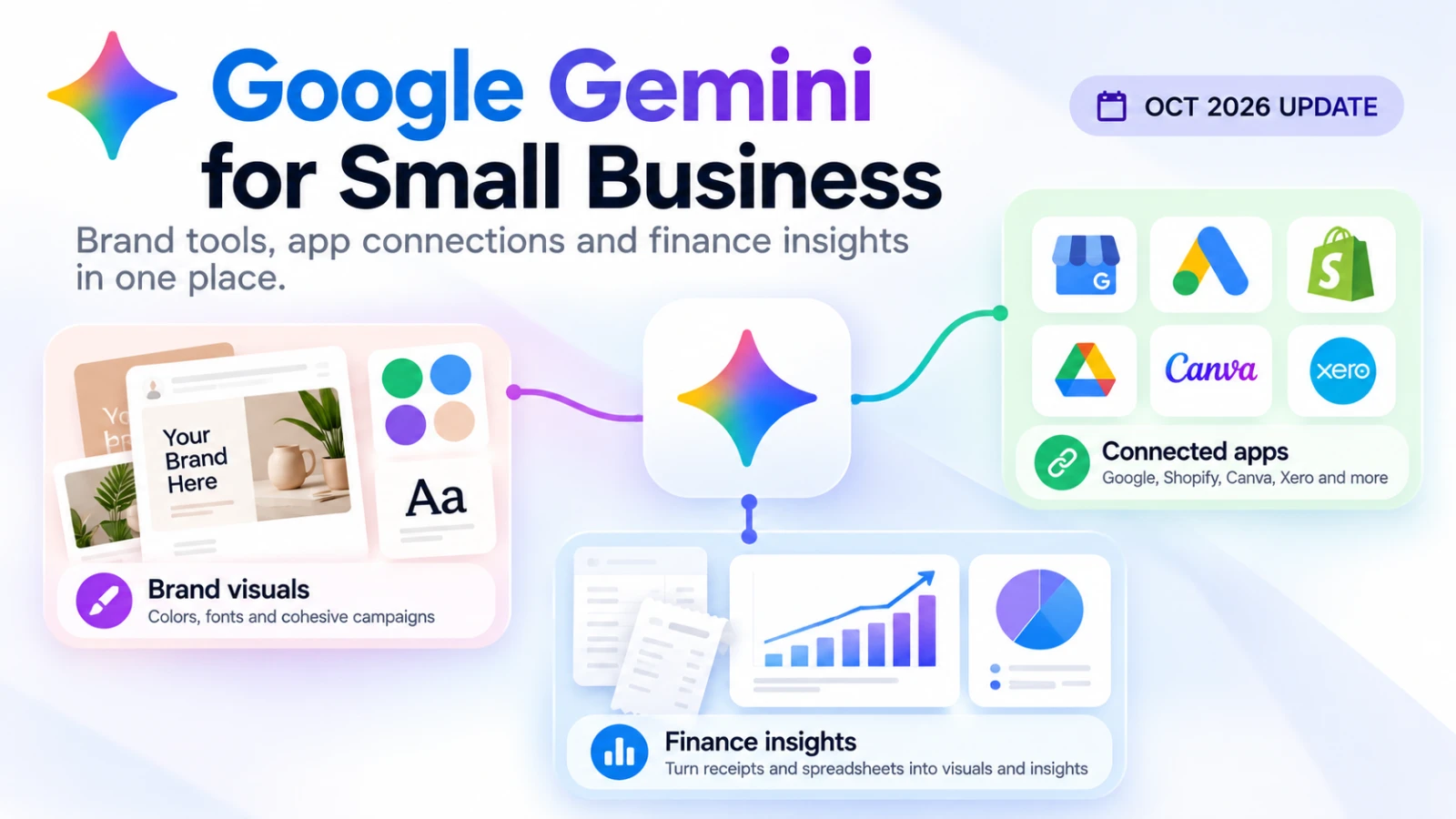
On October 20, 2026, Google announced new business-focused capabilities for its Gemini app, including a dedicated business landing page, reusable brand styles, expanded app connections, and financial analysis features.
The update is significant because it moves Gemini further beyond general-purpose questions and content generation.
Google is positioning it as a place where business owners can work with information from multiple applications.
But does that make Gemini a replacement for dedicated business software?
Not necessarily.
Here's what the announcement means for founders, ecommerce merchants, freelancers, and small teams.
What's New in Gemini for Small Businesses? #
Google's October announcement focuses on four capabilities.
| Feature | What it does |
|---|---|
| Business landing page | Brings business-oriented tasks into a dedicated Gemini experience |
| Brand style customization | Helps generate visuals using a business's existing branding |
| Connected applications | Provides access to supported Google and third-party tools |
| Financial insights | Helps analyze spreadsheets, receipts, and purchase records |
Google says the business landing page, marketing and finance capabilities, and new connected apps are beginning to roll out globally.
Availability will expand gradually rather than reaching every account immediately.
Let's examine the practical value of each feature.
1. A Dedicated Gemini Hub for Business Owners #
The first addition is a business-focused landing page within Gemini.
Google describes it as a central place for activities such as building a brand, analyzing finances, and understanding customer information.
The idea is to reduce the amount of context a business owner must repeatedly provide.
Consider a small online retailer.
The owner may need to prepare promotional content, review sales information, and understand customer questions before planning the next campaign.
Previously, these tasks might have involved separate spreadsheets, design applications, and conversations with an AI assistant.
The new business experience is intended to make these workflows easier to organize within Gemini.
However, a centralized AI interface should not be confused with a complete business-management system.
Merchants still need reliable applications for inventory, transactions, accounting, customer records, and other operational requirements.
The potential benefit is simpler access to information—not the elimination of specialized software.
2. Gemini Can Now Remember a Business's Visual Identity #
One of the more practical additions concerns brand consistency.
Google says businesses can define their visual style by providing materials such as their website, brand kit, fonts, and color palette.
Gemini can then use that context when generating new creative assets.
The announcement identifies Nano Banana 2.1 as the image-generation model supporting these workflows.
Why This Matters #
Imagine a small skincare brand preparing a seasonal promotion.
The business already has established packaging colors, typography, and a recognizable visual style.
Without reusable brand context, the owner might repeatedly explain those requirements whenever generating marketing images.
With the new functionality, Gemini is designed to retain the visual preferences for subsequent creative work.
Potential uses include:
- Promotional graphics
- Product-launch concepts
- Social media campaign assets
- Brand-consistent marketing visuals
What Business Owners Should Still Review #
Brand consistency involves more than selecting the correct colors.
Generated materials should be checked for inaccurate product details, distorted packaging, incorrect text, and misleading visual claims.
Businesses should also ensure that generated designs do not unintentionally imitate another company's identity.
For regulated products, marketing content may require additional legal or compliance review.
The advantage is reducing repetitive creative setup. The limitation is that generated assets still need human approval.
3. More Connections to the Software Businesses Already Use #
The second major development is expanded connectivity.
Google's announcement names integrations involving its own services, including Google Business Profile, Google Ads, and Google Workspace.
It also identifies third-party applications such as Shopify, Canva, and Xero, alongside other business and productivity tools.
This is potentially useful because important business information often lives in different systems.
An ecommerce merchant might manage products in one application, marketing materials in another, and financial records in a third.
A connected assistant can help bring relevant information into a conversation without requiring the owner to manually copy everything between tools.
Example: Preparing an Ecommerce Campaign #
Suppose a store owner wants to plan a promotion.
A useful workflow could involve reviewing available business information, identifying products to highlight, and preparing campaign copy consistent with the brand's style.
Gemini's expanded connections and creative capabilities could support parts of that process.
However, the announcement does not establish that every connected application supports every action.
A connection that provides access to information does not necessarily permit publishing campaigns, changing product prices, or updating financial records.
Before relying on an integration, business owners should confirm what it can read, what it can change, and which permissions it requires.
4. Financial Analysis From Spreadsheets and Receipts #
Google also announced tools intended to make financial information easier to understand.
According to the company, Gemini can work with spreadsheets, receipts, and purchase records to create financial graphics and interactive models.
For a small-business owner, this could make basic financial exploration more accessible.
Example: Understanding Monthly Expenses #
Imagine a freelancer who maintains a spreadsheet containing monthly operating expenses.
The data includes software subscriptions, advertising expenses, travel costs, and contractor payments.
Instead of manually creating every chart, the freelancer could ask Gemini to organize the information and visualize spending patterns.
A useful result might highlight categories with rising expenses or compare spending across months.
The value is not necessarily advanced financial forecasting.
It is making existing information easier to examine.
Important Limitations #
AI-generated financial analysis can contain errors.
A spreadsheet may include missing transactions, duplicated entries, inconsistent dates, or incorrectly categorized expenses.
Gemini may produce a convincing chart without identifying every problem in the underlying data.
Business owners should therefore verify calculations and source records before using generated insights for financial decisions.
These capabilities should not be treated as a replacement for bookkeeping, tax preparation, or professional financial advice.
5. Three Practical Ways Small Businesses Could Use the Update #
The announcement is easiest to evaluate through everyday workflows.
Use Case A: A Local Service Business #
A cleaning company wants to improve its online marketing.
The owner could use Gemini to review available business information, develop campaign ideas, and create visuals aligned with the company's existing identity.
The final promotional content would still need to be checked and published through the appropriate channels.
Use Case B: An Ecommerce Merchant #
An online retailer wants to prepare a product-launch campaign.
Gemini's brand tools could help generate creative concepts, while supported connections may provide relevant context from existing applications.
The merchant should verify product availability, pricing, and promotional claims before using the content.
Use Case C: A Solo Consultant #
A consultant wants to understand operating expenses and prepare a monthly business review.
Gemini could help organize financial information from supplied records and generate visual summaries.
The consultant would still need to reconcile the figures against the original transactions.
Across these examples, the common theme is assistance with work that spans multiple applications.
6. What About Privacy and Business Data? #
Connecting applications to an AI assistant introduces important data-management questions.
Business owners may be working with confidential financial information, customer records, marketing plans, or internal documents.
Before connecting sensitive business systems, owners should review:
- The information an integration can access.
- Whether the connection supports read-only access or additional actions.
- The privacy and data-retention settings associated with the account.
- Whether company policies permit the proposed data sharing.
- How to disconnect an application when access is no longer needed.
Businesses handling customer information should be especially careful about uploading unnecessary personal data.
For organizations with centralized administrative and governance requirements, Google separately offers business-oriented Gemini products.
7. Is the New Gemini Business Experience Free? #
Google says the newly announced business landing page, marketing and finance capabilities, and connected apps are beginning to roll out globally for Gemini app users.
That does not mean every underlying AI capability has identical usage limits or that every integration is immediately available to everyone.
Google's announcement does not provide a separate subscription price for the new business landing page.
Users should distinguish between access to the new interface and the limits associated with their particular Gemini subscription.
The available features may also depend on account type, location, and rollout status.
For businesses evaluating the update, the practical approach is to check the capabilities available in their own account before changing an existing workflow.
8. Can Gemini Replace Business Software? #
This is an important distinction.
Gemini can assist with analyzing information, preparing content, and interacting with supported services.
But businesses still need systems that maintain authoritative operational records.
- An ecommerce platform manages orders and products.
- Accounting software records financial transactions.
- A CRM manages customer relationships and sales processes.
- A design platform provides specialized creative workflows.
Gemini's new capabilities may make information from these systems easier to work with, but they do not automatically replace their core responsibilities.
For many businesses, the more useful question is:
Which existing tasks could benefit from an AI assistant without compromising accuracy or control?
That is a better starting point than attempting to move every business process into one interface.
9. Who Should Try the New Gemini Features? #
The update is particularly relevant to founders and small-business owners who manage several responsibilities themselves.
Solo entrepreneurs may appreciate reusable branding instructions.
Ecommerce merchants may find connected-app workflows useful.
Freelancers could benefit from easier financial visualization.
Small marketing teams may value a more consistent process for generating creative concepts.
However, businesses with complex approval processes, regulated data, or specialized operational requirements should evaluate the integrations carefully.
The strongest use cases are likely to be tasks where Gemini can reduce repetitive preparation while leaving important decisions under human control.
Final Verdict #
Google's October 2026 Gemini update is a meaningful step toward making general-purpose AI more useful for everyday business operations.
The most interesting development is not any single feature.
It is the combination of reusable brand context, connected business applications, and financial analysis within one assistant.
For small-business owners, that could make some routine tasks easier to manage.
The limitations remain important: rollout is gradual, integration capabilities vary, and AI-generated business information still requires verification.
Gemini may become a more useful interface for working with business software, but it is not a substitute for choosing reliable software in the first place.
Discover Software for Your Business #
Whether you're looking for ecommerce platforms, accounting applications, marketing software, or productivity tools, choosing the right combination matters.
Explore software across different categories on Vouchfull and discover tools relevant to your business needs.