

Guides Data, Analytics & BI
Oracle Adds 7 New AI-Powered HR Applications to Fusion Cloud HCM: What's New in October 2026?
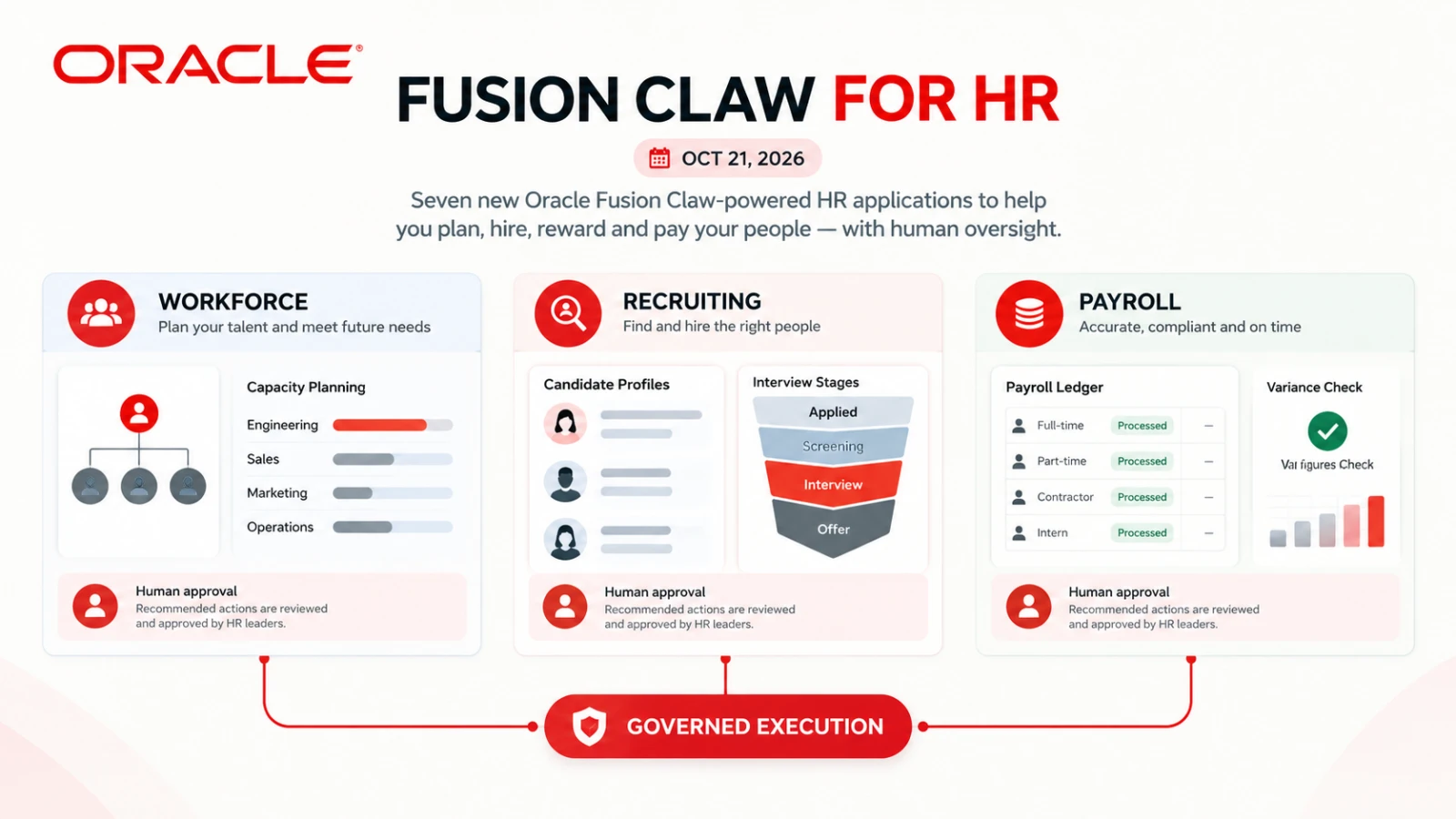
Oracle announced seven new Fusion Claw-powered HR applications on October 21, 2026, covering workforce planning, recruiting, compensation, and payroll. The applications are designed to coordinate complex HR workflows using enterprise data, AI reasoning, and governed execution. Here's what the announcement introduces, how the applications work, and what businesses should consider before adopting th
Oracle Adds 7 New AI-Powered HR Applications to Fusion Cloud HCM: What's New in October 2026? #
Human resources teams manage more than employee records.
They coordinate hiring, workforce planning, compensation, payroll, and operational decisions that depend on information spread across different business systems.
On October 21, 2026, Oracle announced seven new Fusion Claw-powered agentic applications for HR, expanding its enterprise AI capabilities within Oracle Fusion Cloud Human Capital Management (HCM).
The announcement introduces applications covering workforce planning, recruiting, compensation, and payroll operations.
Rather than focusing only on answering questions or generating recommendations, Oracle says the applications can coordinate complex work and prepare actions for execution within organizational policies and approval processes.
The development is particularly relevant for enterprises already using Oracle Fusion Cloud HCM.
Here's what the announcement includes, how the seven applications are designed to work, and what HR leaders should understand before evaluating them.
What Is Oracle Fusion Claw? #
Oracle Fusion Claw is a governed execution runtime designed to support Oracle's Fusion Agentic Applications.
Oracle introduced Fusion Claw on September 29, 2026, describing it as a way to combine AI reasoning with deterministic enterprise computation.
The October HR announcement applies that runtime to additional workforce processes.
The important distinction is between an AI assistant and an application designed to coordinate a business outcome.
A conventional assistant might help an HR manager summarize workforce information or draft a recruiting email.
An agentic application can work across relevant enterprise information, evaluate options, coordinate steps, and prepare actions according to defined organizational rules.
Oracle says Fusion Claw supports:
- Complex, longer-running workflows
- Continuous replanning as circumstances change
- AI reasoning and enterprise computation
- Governed automation
- Organizational policies and approval controls
The objective is to move beyond isolated assistance toward coordinated business execution.
However, this does not mean every HR decision becomes fully autonomous.
Oracle specifically describes human-approved actions and established governance controls as part of the new HR applications.
The 7 New Oracle Fusion Claw HR Applications #
Oracle's October announcement introduces seven applications across three areas of HR operations.
| Business area | Application | Main purpose |
|---|---|---|
| Workforce planning | Workforce Orchestration | Develop and coordinate workforce plans |
| Workforce planning | Positions Command Center | Identify position-related conflicts and risks |
| Talent acquisition | Candidate Sourcing | Organize candidate pipelines and recruiting outreach |
| Talent acquisition | Recruiting Command Center | Coordinate hiring workflows |
| Compensation | Workforce Compensation | Prepare budget-aligned compensation recommendations |
| Payroll | Payroll Command Center | Identify potential payroll issues |
| Payroll | Payroll Activity Workspace | Analyze payroll and financial reporting information |
The applications are intended to work with information already available within Oracle Fusion Applications.
Let's examine what each group means for HR teams.
1. Workforce Orchestration: Planning Beyond Headcount #
Workforce Orchestration focuses on developing workforce plans that balance changing business demand, costs, and operational continuity.
Oracle says the application evaluates different workforce options, including:
- Employee development
- Redeployment
- Hiring
- External talent
It can coordinate actions after the appropriate organizational review and approval.
Example: A Business Expanding Its Operations #
Imagine a company preparing to expand its customer support operations.
The organization expects higher demand but needs to control labor costs.
Its HR team must determine whether to recruit additional employees, redeploy existing staff, or develop employees with the necessary skills.
That decision involves workforce availability, business demand, operational requirements, and financial constraints.
Workforce Orchestration is designed to evaluate these alternatives and help coordinate the resulting plan.
The potential advantage is that HR leaders can examine multiple options rather than manually assembling information from different workforce processes.
However, workforce planning still depends on reliable data.
Incorrect employee skills, outdated availability information, or unrealistic demand assumptions can produce misleading recommendations.
The application should therefore support planning decisions rather than replace HR judgment.
2. Positions Command Center: Identifying Workforce Conflicts #
The second workforce application is Positions Command Center.
Oracle describes it as connecting information involving positions, employees, recruiting, costs, and approvals.
Its purpose is to identify conflicts and potential downstream risks associated with position changes.
For example, changing a position may affect recruiting plans, workforce budgets, employee assignments, and approval requirements.
Those relationships can become difficult to manage when different teams maintain separate processes.
Why This Matters #
Consider a company reorganizing one of its departments.
A proposed position change might create a conflict with an existing recruiting plan or an approved workforce budget.
Positions Command Center is designed to surface those relationships and route recommended corrective actions for review.
The benefit is better visibility into the consequences of workforce changes.
The limitation is that identifying a conflict does not automatically resolve the underlying business decision.
HR leaders still need to determine which changes are appropriate and ensure that the resulting actions comply with organizational policies.
3. Candidate Sourcing: Coordinating Recruiting Outreach #
Recruiting is another area covered by the October announcement.
Candidate Sourcing is designed to analyze workforce demand, organize candidates for appropriate action, and coordinate outreach and follow-up communications.
Oracle says the application can work within established recruiting processes and approvals.
Example: Filling a Priority Role #
A company needs to recruit several employees for an important business function.
Recruiters must understand the workforce requirement, identify relevant candidates, organize outreach, and manage follow-up activities.
Candidate Sourcing is intended to help coordinate those activities using available workforce and recruiting information.
The application could make it easier for recruiting teams to organize candidate pipelines and prepare communications.
However, candidate sourcing is not the same as making a final hiring decision.
Recruiters still need to review candidate qualifications, verify information, and ensure that recruiting practices comply with applicable employment requirements.
AI-generated outreach also requires review for accuracy, relevance, and appropriate communication.
4. Recruiting Command Center: Keeping Hiring Workflows Organized #
Recruiting Command Center focuses on coordinating the hiring process.
Oracle says it brings together information involving:
- Job requirements
- Candidates
- Interviews
- Feedback
- Offers
- Workforce demand
The application highlights recruiter actions and candidates who may be ready to advance.
It can also prepare next steps for recruiter consideration and approval.
Example: Managing Multiple Interviews #
Imagine a recruiting team handling several open positions.
Different candidates may be waiting for interviews, feedback, or decisions.
Recruiters need to identify which activities require attention and coordinate the next steps.
Recruiting Command Center is designed to provide a consolidated view of that information.
The potential benefit is reducing the effort required to track hiring progress across multiple activities.
However, a consolidated workflow does not eliminate the need for recruiter oversight.
Candidate evaluations, interview feedback, and employment decisions should remain subject to appropriate review.
5. Workforce Compensation: Preparing Budget-Aligned Recommendations #
Compensation planning involves more than calculating salaries.
HR teams must consider budgets, employer-defined pay guidelines, organizational criteria, and relevant equity considerations.
Oracle's Workforce Compensation application is designed to evaluate compensation options against those requirements.
It can prepare recommendations aligned with organizational policies for human review and approval.
Example: Annual Compensation Planning #
A company preparing its annual compensation review needs to evaluate proposed changes across departments.
Managers may submit recommendations that must be considered alongside available budgets and established compensation guidelines.
Workforce Compensation is intended to help HR teams evaluate those options and prepare plans for review.
This could make compensation planning easier to coordinate.
However, compensation decisions require careful consideration of employee circumstances, organizational policy, and applicable legal requirements.
AI-generated recommendations should not be treated as automatically fair or correct.
Organizations need appropriate controls, review processes, and reliable underlying data.
6. Payroll Command Center: Identifying Potential Payroll Issues #
Payroll is one of the most sensitive areas of HR operations.
Errors can affect employee payments, reporting, compliance, and trust.
Oracle's Payroll Command Center is designed to review information including:
- Employee data
- Payroll imports
- Timecards
- Retroactive changes
- Historical patterns
The application identifies potential issues and possible causes.
It can also prepare recommended follow-up actions for review.
Example: Preparing for a Payroll Run #
A payroll team preparing its next processing cycle needs to identify missing information, unusual changes, and potential discrepancies.
Some issues may involve incorrect timecards.
Others may relate to employee records or retroactive adjustments.
Payroll Command Center is intended to help teams identify these situations before they become larger operational problems.
The potential value is earlier visibility into payroll readiness.
However, identifying a potential issue does not establish that an error has occurred.
Payroll professionals must review the underlying records and verify the appropriate correction.
7. Payroll Activity Workspace: Understanding Payroll Variations #
The seventh application is Payroll Activity Workspace.
Oracle says it supports payroll and financial reporting by comparing current pay, balances, and costs with previous periods.
It highlights material variations and prepares recommended follow-up actions.
Example: Investigating Payroll Cost Changes #
A company notices that payroll costs have increased compared with the previous month.
The HR and finance teams need to understand whether the change reflects additional employees, compensation adjustments, overtime, or other factors.
Payroll Activity Workspace is designed to help examine these variations using available payroll information.
The application could make it easier to identify areas requiring further investigation.
However, a change in payroll costs does not automatically indicate a problem.
Business owners and payroll professionals need to interpret the information in context.
How the Applications Work Together #
The most interesting aspect of Oracle's announcement is the connection between different HR processes.
Workforce planning influences recruiting.
Recruiting affects employee availability and operational capacity.
Compensation influences labor costs.
Payroll reflects the financial consequences of workforce activity.
These processes are connected, but organizations often manage them through different teams and workflows.
Oracle's approach is to use enterprise information to coordinate work across those areas.
For example, a workforce planning process may identify a staffing requirement.
Recruiting applications can help coordinate candidate sourcing and hiring activities.
Compensation applications can prepare budget-aligned recommendations.
Payroll applications can identify operational issues and analyze financial variations.
This creates the possibility of more connected HR workflows.
The important question is whether organizations have accurate data, appropriate permissions, and clearly defined processes.
Without those foundations, additional automation can make existing problems harder to identify.
Human Approval and Governance Remain Important #
Oracle emphasizes governance and human oversight in its October announcement.
The applications can prepare and coordinate actions, but Oracle describes HR actions as subject to organizational review and approval.
This distinction matters because HR decisions can directly affect employees.
Organizations should establish appropriate controls for:
- Recruiting and candidate evaluation
- Position changes
- Compensation recommendations
- Payroll corrections
- Employee information access
- Approval authority
Employment decisions remain the responsibility of the organization.
Businesses should also review how sensitive employee information is accessed and used.
AI-generated recommendations need to be evaluated for accuracy, fairness, and consistency with organizational policies.
The availability of automation does not remove those responsibilities.
Who Should Evaluate the New Applications? #
The announcement is particularly relevant to organizations already using Oracle Fusion Cloud HCM.
Businesses with complex workforce planning, recruiting, compensation, and payroll processes may find the applications worth evaluating.
Potentially relevant organizations include:
Large Enterprises #
Companies managing substantial workforces may benefit from coordinating information across departments and operational processes.
Multi-Location Businesses #
Organizations operating across different locations may need to balance staffing requirements, availability, and operational constraints.
Recruiting Teams #
Companies handling multiple hiring processes may value consolidated candidate and workflow information.
Payroll and Finance Teams #
Organizations reviewing payroll readiness and financial variations may find the analysis capabilities relevant.
Smaller businesses using separate HR applications should not assume that the new applications are available as independent products.
Oracle's announcement places them within Oracle Fusion Cloud HCM.
Availability and Pricing: What Oracle Has Confirmed #
Oracle announced the seven new applications at the HR Technology Conference in Las Vegas on October 21, 2026.
The company describes them as available within Oracle Fusion Cloud HCM.
However, the announcement does not provide a separate price for each of the seven applications.
It also does not establish a universal rollout date or confirm that every existing customer has immediate access to every capability.
Businesses evaluating the applications should confirm availability, licensing, and applicable commercial terms directly with Oracle.
They should also establish which workflows are supported by their current configuration and what additional implementation work may be required.
What the Announcement Does Not Establish #
The new applications represent an important expansion of Oracle's enterprise AI capabilities.
But several questions remain relevant to buyers.
Oracle has not provided a separate price for these seven applications in the October announcement.
The announcement also does not provide independent performance benchmarks demonstrating how much time or cost each application will save.
Businesses should not assume that every workflow can operate without human involvement.
Nor should they assume that AI-generated workforce, recruiting, compensation, or payroll recommendations are automatically accurate.
The practical value will depend on the organization's existing Oracle environment, data quality, configuration, and governance requirements.
Final Verdict #
Oracle's October 2026 announcement expands Fusion Claw into seven additional HR-focused applications covering workforce planning, recruiting, compensation, and payroll.
The most important development is the emphasis on coordinating work across connected enterprise processes.
For organizations already using Oracle Fusion Cloud HCM, these applications could provide another way to organize workforce operations and identify activities requiring attention.
However, adoption requires more than enabling AI functionality.
Businesses need reliable workforce data, clear approval policies, appropriate access controls, and human review.
The applications are best understood as tools for supporting and coordinating HR work—not replacements for responsible HR management.
Discover HR and Business Software #
HR teams have different requirements depending on their workforce size, processes, and existing systems.
Some organizations need enterprise human capital management platforms.
Others need specialized recruiting, payroll, employee engagement, or workforce planning software.
Explore business software and relevant product categories on Vouchfull to discover tools that fit your organization's requirements.