

Comparisons
Shopify vs WooCommerce in 2026: Which Is Better for Your Online Store?
Shopify and WooCommerce can both power a successful online store, but their costs, flexibility, maintenance requirements, and checkout workflows differ significantly. This practical 2026 comparison examines pricing, hosting, SEO, payments, customization, and scalability to help founders and ecommerce businesses choose the platform that fits their technical skills, budget, and long-term plans.
Shopify vs WooCommerce in 2026: Which Is Better for Your Online Store? Choosing an ecommerce platform is one of the earliest decisions that can shape how a business operates.
It affects more than the appearance of a website. Your platform influences how you manage products, accept payments, install integrations, handle technical maintenance, and expand into new markets.
Two popular approaches are Shopify and WooCommerce.
Shopify offers a hosted commerce platform with integrated store-management capabilities. WooCommerce provides an open-source ecommerce solution built on WordPress, giving merchants more direct control over their website and infrastructure.
Neither approach is universally better.
A founder launching a first store may value simplicity and predictable administration. An established business with an experienced development team may prioritize customization and infrastructure control.
This guide compares both platforms using their published features, documentation, and pricing—not unverified performance claims. Shopify vs WooCommerce: Quick comparison Feature Shopify WooCommerce Platform type Hosted ecommerce service Open-source WordPress plugin Hosting Included Arranged separately Software cost Subscription plans Core plugin is free Technical maintenance Much of the platform infrastructure is managed Merchant or hosting provider manages more of the stack Customization Themes, apps, APIs, and supported platform extensions WordPress plugins, themes, and direct code access Payments Shopify Payments where supported, plus third-party providers Payment gateways through integrations SEO Built-in tools and apps WordPress SEO tools and plugins Best fit Merchants prioritizing convenience Merchants prioritizing control The most important difference is how much technical responsibility you want to manage yourself.
- Pricing: Which platform costs less? Pricing is often the first comparison merchants make, but subscription fees alone do not reveal the full cost of operating a store. Shopify pricing in 2026 Shopify publishes several subscription tiers.
Its US pricing page currently lists the following prices when billed annually: Plan Advertised monthly equivalent Basic $29 Grow $79 Advanced $299 Plus From $2,300 Monthly billing is generally more expensive than the annual equivalent. Pricing, payment rates, and availability vary by country.
Shopify
Shopify includes core store hosting in its subscription.
However, merchants may incur additional costs for paid themes, third-party apps, domain registration, payment processing, and other services.
For example, a merchant might pay for an email marketing service, customer support software, and a product subscription app.
These expenses should be included in the operating budget. WooCommerce pricing in 2026 WooCommerce's core plugin is free and open source.
That does not make running a WooCommerce store free.
Typical expenses may include:
- WordPress hosting and domain registration.
- Premium themes or design services.
- Paid plugins and extensions.
- Payment processing.
- Backups, security, and maintenance.
- Developer assistance when required. WooCommerce's documentation confirms that free extensions and paid marketplace extensions follow different update and subscription arrangements.
WooCommerce +1
A simple WooCommerce store can be economical, particularly when a business already uses WordPress.
A heavily customized store can become more expensive to maintain.
Verdict: Shopify offers a clearer starting subscription structure. WooCommerce offers more freedom to assemble a cost structure, but total expenses depend heavily on hosting, extensions, and technical support. 2. Ease of use: Which is easier for beginners? Shopify is designed around a managed ecommerce experience.
Merchants can configure products, choose a theme, connect payment methods, and manage orders through its administration interface.
They generally do not need to arrange a separate hosting environment or maintain the underlying ecommerce platform themselves.
This makes Shopify attractive to founders who want to focus primarily on selling products.
WooCommerce works differently.
Before launching, a merchant typically needs a WordPress website, hosting, and the WooCommerce plugin.
The setup process can involve selecting a theme, configuring payment and shipping extensions, and checking compatibility between plugins.
For someone familiar with WordPress, these steps may be straightforward.
For a first-time website owner, they introduce additional decisions.
Verdict: Shopify generally has the easier starting experience. WooCommerce becomes more approachable when the merchant already understands WordPress or works with a developer. 3. Customization: Where WooCommerce has an advantage Customization is one of WooCommerce's strongest selling points.
Because it is open source and runs within WordPress, developers can modify themes, extend functionality, integrate custom services, and build specialized commerce workflows.
Imagine a business that sells configurable industrial products.
Customers might need to specify measurements, materials, packaging, or delivery requirements before receiving a quotation.
WooCommerce can support custom workflows through extensions or development work.
Shopify also offers substantial customization through its themes, apps, APIs, and supported extension mechanisms.
Many businesses can build sophisticated stores without modifying core platform infrastructure.
However, Shopify operates within a managed environment, and certain capabilities depend on the merchant's plan and supported platform interfaces.
Verdict: WooCommerce provides more direct control over the underlying application. Shopify is often simpler when the required functionality is available through its supported features and app ecosystem. 4. SEO: Is WooCommerce better than Shopify? There is no reliable basis for claiming that every WooCommerce store ranks better than every Shopify store, or vice versa.
Search performance depends on content quality, site structure, technical implementation, competition, and user experience.
Both platforms can support important ecommerce SEO practices. Shopify SEO Shopify provides features for managing product and collection pages, page titles, descriptions, redirects, and other storefront elements.
Merchants can also use themes and apps to improve specific workflows.
Because hosting is managed, businesses avoid some infrastructure decisions that otherwise require technical expertise.
However, they still need to maintain useful content, logical navigation, internal links, and well-optimized product pages. WooCommerce SEO WooCommerce benefits from the WordPress ecosystem.
Merchants can use WordPress content-management features and SEO plugins to control many aspects of their site.
This can be particularly attractive to businesses investing heavily in educational content, buying guides, and editorial landing pages.
The flexibility comes with responsibility.
Poorly configured plugins, slow hosting, duplicate pages, and technical errors can undermine search visibility.
Verdict: Choose based on your content strategy and technical resources. Neither platform automatically delivers superior Google rankings. 5. Payments and checkout Checkout reliability and payment availability directly affect whether customers can complete purchases.
Shopify provides an integrated checkout experience and supports Shopify Payments in eligible regions, alongside third-party payment providers.
The cost structure depends on the merchant's location, subscription tier, and selected provider.
For example, Shopify's India pricing page lists additional third-party payment provider fees that vary by plan.
Shopify India
WooCommerce supports payment processing through gateway integrations.
This allows merchants to choose providers according to local availability, business requirements, and supported payment methods.
WooCommerce also documents how payment integrations may share relevant transaction and customer information with the selected provider.
WooCommerce
Before choosing either platform, merchants should verify:
- Whether their preferred payment provider is supported.
- Which currencies and payment methods are available.
- Processing fees and any additional platform fees.
- Refund and dispute-handling workflows.
- Support for recurring payments, if needed. Verdict: Shopify offers a more integrated checkout setup. WooCommerce gives merchants considerable gateway flexibility, although configuration and compatibility may require more work.
- Security and maintenance Both platforms can support secure online stores, but their maintenance models differ.
With Shopify, the provider manages much of the underlying hosted infrastructure.
Merchants remain responsible for appropriate account access, application permissions, business processes, and the security implications of third-party integrations.
With WooCommerce, store operators must also consider the security and maintenance of their WordPress installation, hosting environment, themes, and plugins.
WooCommerce recommends testing updates on a staging site, maintaining backups, and checking critical shopping workflows after changes.
WooCommerce
Consider a store with several extensions for payments, shipping, and subscriptions.
An update to one component can sometimes affect another.
A disciplined maintenance process helps identify these issues before customers encounter them.
Verdict: Shopify reduces infrastructure-maintenance responsibilities. WooCommerce offers more control but requires a clearer maintenance plan. 7. Apps, plugins, and integrations A modern ecommerce store rarely operates using only its platform's core features.
Merchants often need software for customer support, inventory synchronization, analytics, email marketing, shipping, subscriptions, and accounting.
Shopify uses its app ecosystem to extend store functionality.
WooCommerce relies on WordPress plugins, WooCommerce extensions, and custom integrations.
Both approaches offer useful possibilities, but extension quality matters.
Before adding any app or plugin, evaluate its documentation, maintenance history, permissions, pricing, compatibility, and support arrangements.
Installing many extensions is not automatically a sign of a better store.
Every integration introduces operational complexity.
For example, a merchant using separate tools for abandoned-cart reminders, live chat, reviews, and marketing automation should check whether those tools duplicate functionality or conflict with existing workflows.
Verdict: Both platforms offer extensive extensibility. Shopify emphasizes managed integrations; WooCommerce offers broader direct control over the WordPress environment. 8. Scalability: Which platform is better for growing businesses? Scalability is not just about how many products a platform can store.
It includes traffic management, operational complexity, international selling, inventory workflows, team permissions, and the ability to support new business requirements.
Shopify provides higher-tier plans with additional commerce capabilities.
Its current pricing documentation distinguishes plans for solo entrepreneurs, growing teams, international operations, and more complex businesses.
Shopify
WooCommerce can also support substantial ecommerce operations, but performance and reliability depend on the hosting architecture, application design, integrations, and ongoing maintenance.
A business with a capable engineering team may value that control.
A smaller merchant may prefer to avoid managing infrastructure as order volume grows.
Verdict: Both can support business growth. Shopify is attractive for merchants seeking managed operations, while WooCommerce suits businesses prepared to manage a more customizable technical stack. 9. Real-world scenarios: Which should you choose? Scenario A: A first-time fashion store A founder wants to launch a clothing brand with product variants, online payments, discount codes, and basic shipping integrations.
They have limited technical experience.
Recommended starting point: Shopify.
The managed setup allows them to focus on products, merchandising, and customer acquisition. Scenario B: An established WordPress business A company already operates a content-heavy WordPress website and wants to begin selling digital products.
Its team understands WordPress maintenance.
Recommended starting point: WooCommerce.
The business can integrate ecommerce into its existing publishing environment without necessarily moving to another platform. Scenario C: A highly customized B2B store A manufacturer needs unusual product configurations, custom quotation requests, and integration with internal systems.
Recommended starting point: Evaluate WooCommerce first, while also reviewing Shopify's supported B2B and extensibility capabilities.
The final decision should depend on a technical proof of concept rather than assumptions. Scenario D: A growing international brand A retailer wants to expand across markets while keeping store administration relatively centralized.
Recommended starting point: Shopify, with careful evaluation of its international commerce capabilities and relevant subscription tiers. 10. Five questions to ask before choosing Before committing to either platform, answer these questions:
- Who will maintain the store? If there is no technical owner, managed hosting may be preferable.
- How unusual are your business requirements? Custom workflows may justify more infrastructure control.
- What is your real monthly budget? Include hosting, apps, extensions, payment fees, and maintenance.
- How important is content marketing? Evaluate how easily your team can publish and manage SEO content.
- What happens as the business grows? Consider integrations, operational processes, and the cost of future changes. A small proof-of-concept store can reveal practical limitations before a major investment. Final verdict: Shopify or WooCommerce? For most first-time merchants who want a straightforward managed store, Shopify is the easier starting recommendation.
For businesses that already use WordPress, require extensive customization, or want direct control over their ecommerce environment, WooCommerce deserves serious consideration.
Neither platform guarantees better sales, stronger SEO, or lower operating costs.
The better choice is the one that matches your team's capabilities and the store's actual requirements. Discover software for your ecommerce business Your ecommerce platform is only one part of your technology stack.
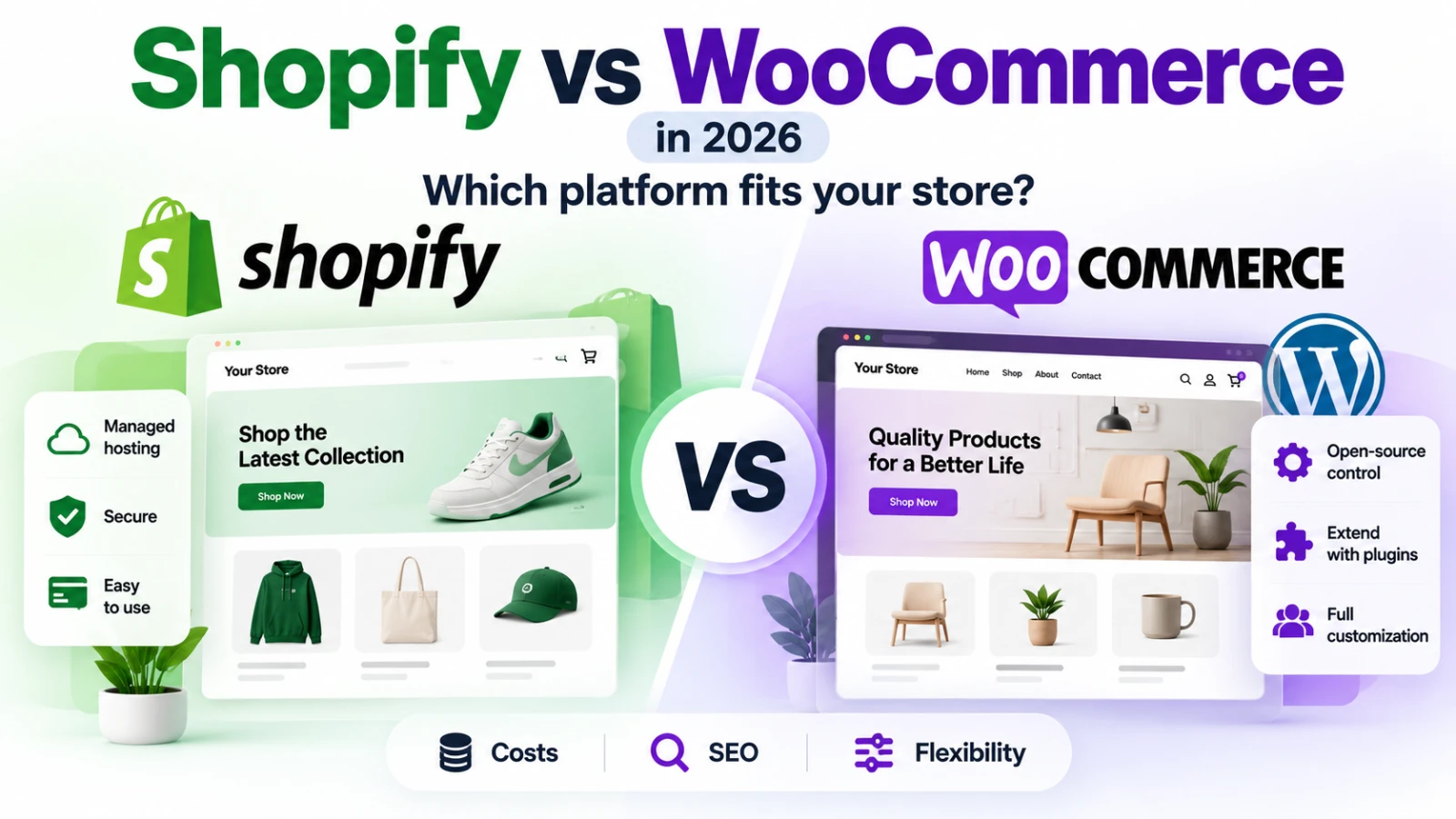
Explore ecommerce, marketing, customer support, analytics, and other business software on Vouchfull to discover tools relevant to your store's next stage. Image The featured banner above uses a side-by-side Shopify and WooCommerce comparison, with recognizable branding and the main decision factors: hosting, customization, costs, SEO, and flexibility.
Download featured banner Tools discussed Candidate slugs only. Exact Vouchfull database slugs have not been verified. shopify woocommerce
Editor-only notes Field Recommendation Suggested category Ecommerce — provisional; confirm against the Vouchfull taxonomy Focus keyword Shopify vs WooCommerce Secondary keywords Shopify vs WooCommerce 2026, WooCommerce vs Shopify pricing, best ecommerce platform, Shopify vs WordPress ecommerce Article type Evergreen comparison Audience Ecommerce founders, small businesses, agencies, online retailers Publication status Prepared for review; not published Official sources: Shopify pricing (US), Shopify pricing (India), WooCommerce maintenance documentation, and WooCommerce extensions documentation.
Internal linking: Add links to verified Shopify and WooCommerce product pages on Vouchfull, along with your actual ecommerce and business-software category pages.
Topic rationale: This targets a durable commercial search query, diversifies coverage away from AI coding and cybersecurity news, and is relevant to both software buyers and product owners.
Pre-publication check: Confirm current regional prices, applicable payment fees, and actual product listing slugs before publishing.